Quick answer: What are current home loan interest rates in India in 2026?
As of 20 August 2026, selected official lender pages show home-loan pricing beginning around the low-to-mid 7% range for some strong borrower profiles and special products, while standard or profile-based rates can be materially higher. There is no single “current home loan rate” for every borrower: your final rate depends on credit profile, income, employment, existing EMIs, loan amount, LTV, property and the lender’s own pricing rules.
If you are comparing home loans today, the most dangerous mistake is to treat every “starting from” rate as if it were a rate you will definitely receive. This guide separates advertised starting rates, profile-specific rates, standard rate tables and contracted-rate ranges so that you can compare more intelligently.
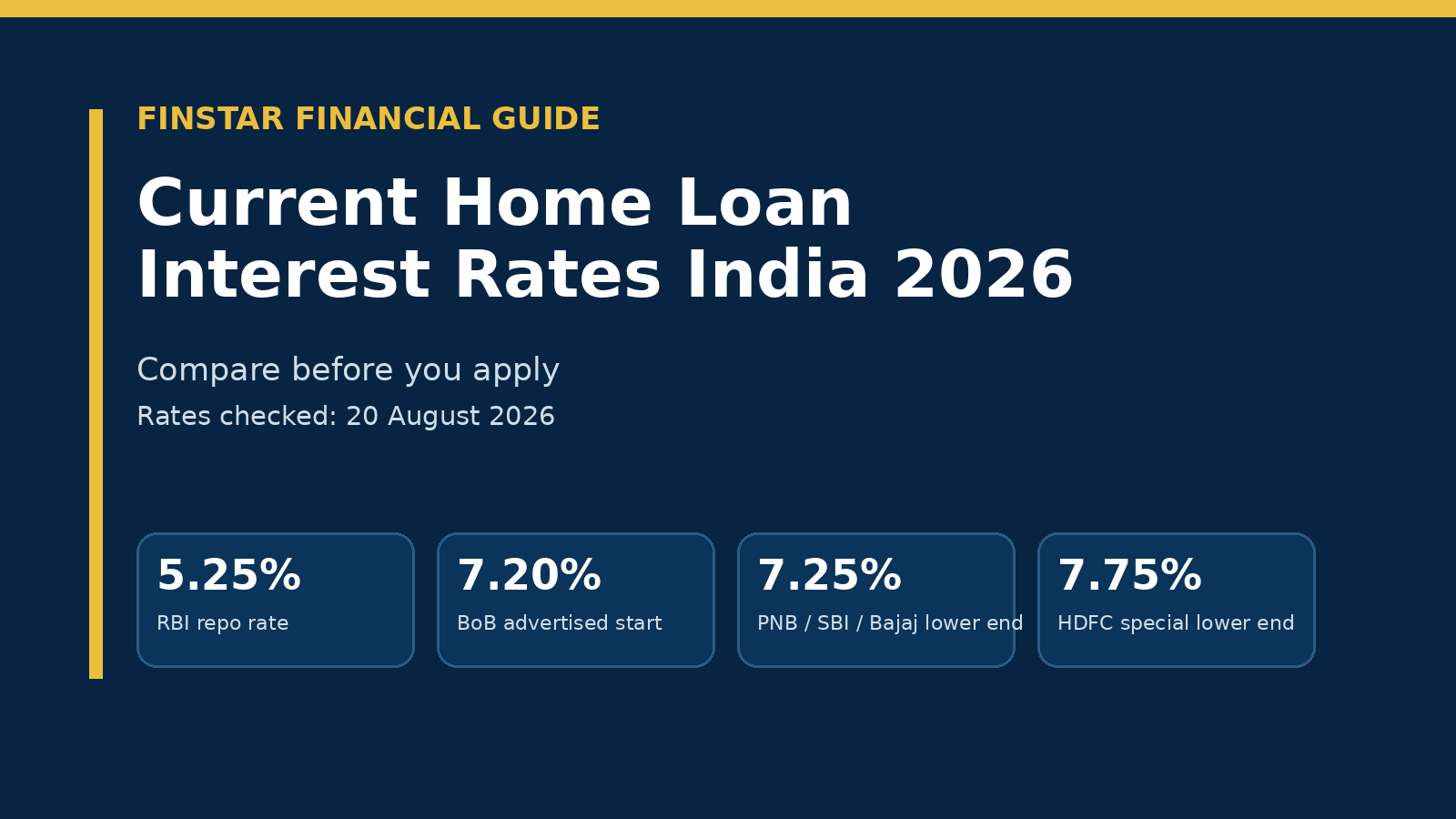
5.25%RBI policy repo rate
7.20%Bank of Baroda advertised start
7.25%PNB / SBI / Bajaj lower end
7.75%HDFC special lower end
Current Home Loan Interest Rates in India 2026
The comparison below uses official lender pages checked on 20 August 2026. The rows are intentionally labelled by basis, because the numbers are not all directly comparable.
| Lender | Published Rate / Range | Who / What It Applies To | How to Read It |
|---|---|---|---|
| LIC Housing Finance | 7.15% (profile-specific) | CIBIL ≥825; loan up to ₹5 crore | Profile/slab rate, not universal |
| Bank of Baroda | Starting @ 7.20% | Official home-loan page | Advertised starting rate |
| PNB | Starting @ 7.25% | CIBIL 800+; >₹30 lakh; LTV ≤80% | Current profile-linked example |
| SBI | 7.25% p.a. onwards | Effective 1 Apr 2026 | T&C apply |
| Bajaj Housing Finance | 7.25%–10.25% salaried | Floating home loan | Self-employed: 7.70%–10.65% |
| HDFC Bank | 7.75%–13.20% special housing rates | All loan slabs shown on current rate page | Policy Repo + spread |
| Axis Bank | 8.00%–8.85% | CIBIL 751+ | 750/below or no history: 8.20%–9.10% |
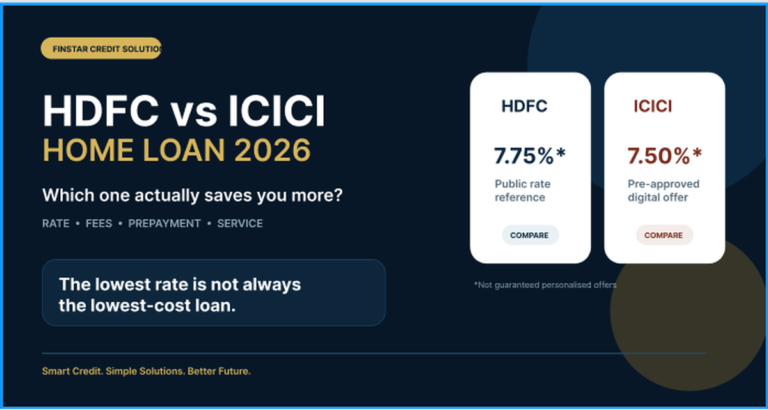
| ICICI Bank | 8.50%+ in current August tables | Special/standard tables | Page headline also mentions 7.50%*; verify promo eligibility |
| Canara Bank | 7.15%–10.00% contracted range | Retail housing loans | Mean contracted rate 8.06%; not an advertised quote |
Important rate disclaimer
Rates are indicative and subject to change. The rate offered to an individual borrower may vary based on credit profile, loan amount, LTV, income/employment profile, property, lender policy and product variant. Always confirm the final rate, fees and charges with the lender before making a decision.
How Published Rates Compare
This chart gives a quick market orientation using the lower-end or starting figure visible on selected official pages. It is not a like-for-like ranking: some values are promotional starts and some are tied to a specific credit-score profile.
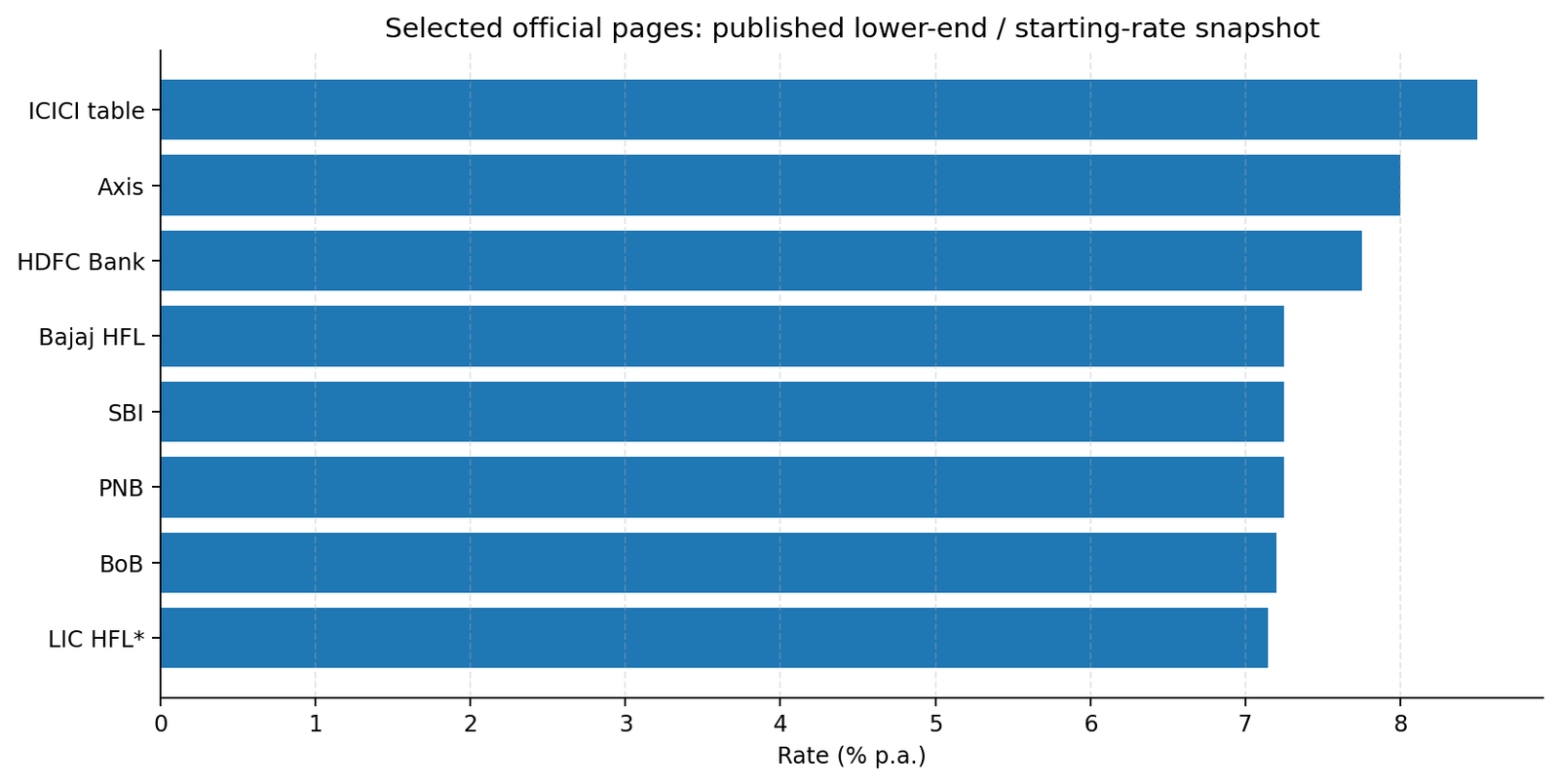
Canara Bank is intentionally not plotted in the bar chart. Its official page reports a contracted housing-loan range of 7.15%–10.00% with a mean rate of 8.06%, which is a different disclosure basis from an advertised starting rate.
What Each Major Lender Is Publishing Right Now
Bank of Baroda — starting at 7.20%
Bank of Baroda’s official home-loan page currently displays “home loan starting @7.20%”. The same page also uses 7.20% as the default rate in its EMI calculator. Final pricing still depends on eligibility and lender assessment.
PNB — starting at 7.25%
Punjab National Bank’s current retail-rate table shows a housing-loan floating rate of 7.25% for CIBIL 800+ in the example where the loan is above ₹30 lakh and LTV is at or below 80%. For the same broad condition, the table shows 7.30% for 750+, 7.85% for 700–749 and 9.05% for 600–699.
SBI — 7.25% p.a. onwards
SBI’s official current home-loan rate page states 7.25% p.a. onwards, effective from 1 April 2026, with terms and conditions applying.
Bajaj Housing Finance — 7.25%–10.25% for salaried borrowers
Bajaj Housing Finance currently publishes 7.25%–10.25% for salaried floating home loans and 7.70%–10.65% for self-employed borrowers. It explicitly says pricing considers factors including credit score, income, employment/profession type, indebtedness, ticket size, tenure and collateral.
LIC Housing Finance — 7.15% for a top-score profile
LIC HFL’s official home-loan table shows 7.15% for CIBIL 825+ and loan up to ₹5 crore, with progressively higher rates for lower credit-score bands and larger loan slabs.
HDFC Bank — special housing rates 7.75%–13.20%
HDFC Bank’s current home-loan rate page shows the policy repo rate at 5.25% and a special housing-loan range of 7.75%–13.20% for the table shown on the page. The lender states that the actual rate is affected by factors such as income, credit profile, employment category, property type and loan value.
Axis Bank — 8.00%–8.85% for CIBIL 751+
Axis Bank currently shows 8.00%–8.85% for CIBIL 751+ and 8.20%–9.10% for 750/below or no credit history. Its page explicitly says the rate varies with customer profile, loan variant and other risk factors.
ICICI Bank — current August tables start at 8.50%
ICICI’s August 2026 special-rate table shows 8.50% for salaried borrowers with credit score 800 and 8.50% for the 750–800 band; its standard-rate table runs from 8.50% up to 9.80% depending on loan slab and borrower type. The page headline also advertises a lower “starting at 7.50%” figure, so borrowers should verify the exact eligibility and conditions of any promotional rate instead of assuming the headline rate applies to them.
Canara Bank — contracted housing-loan range 7.15%–10.00%
Canara Bank publishes a contracted housing-loan range of 7.15%–10.00% with a mean rate of 8.06% on its retail-loan rate-range page. This is useful market information, but it should not be read in the same way as a “starting from” offer.
RBI Repo Rate: Why 5.25% Matters to Home-Loan Borrowers
5.25%Policy Repo Rate
5.00%Standing Deposit Facility
5.50%MSF / Bank Rate
The Reserve Bank of India currently shows the policy repo rate at 5.25%. Many floating-rate retail loans are linked directly or indirectly to an external benchmark or lender benchmark, with a spread added for the borrower and product. That is why two borrowers can see the same repo rate but receive different final home-loan rates.
Headline Rate vs Your Final Rate
Headline / Starting RateThe number shown in an advertisement or landing page
↓
Credit ProfileCIBIL, repayment history and recent credit behaviour
↓
Income & EmploymentSalary, stability, employer or business profile
↓
Loan StructureAmount, LTV, tenure, property and product variant
↓
Final Sanctioned RateThe rate that actually matters to your EMI and total cost
How Much Difference Can 1.25% Make?
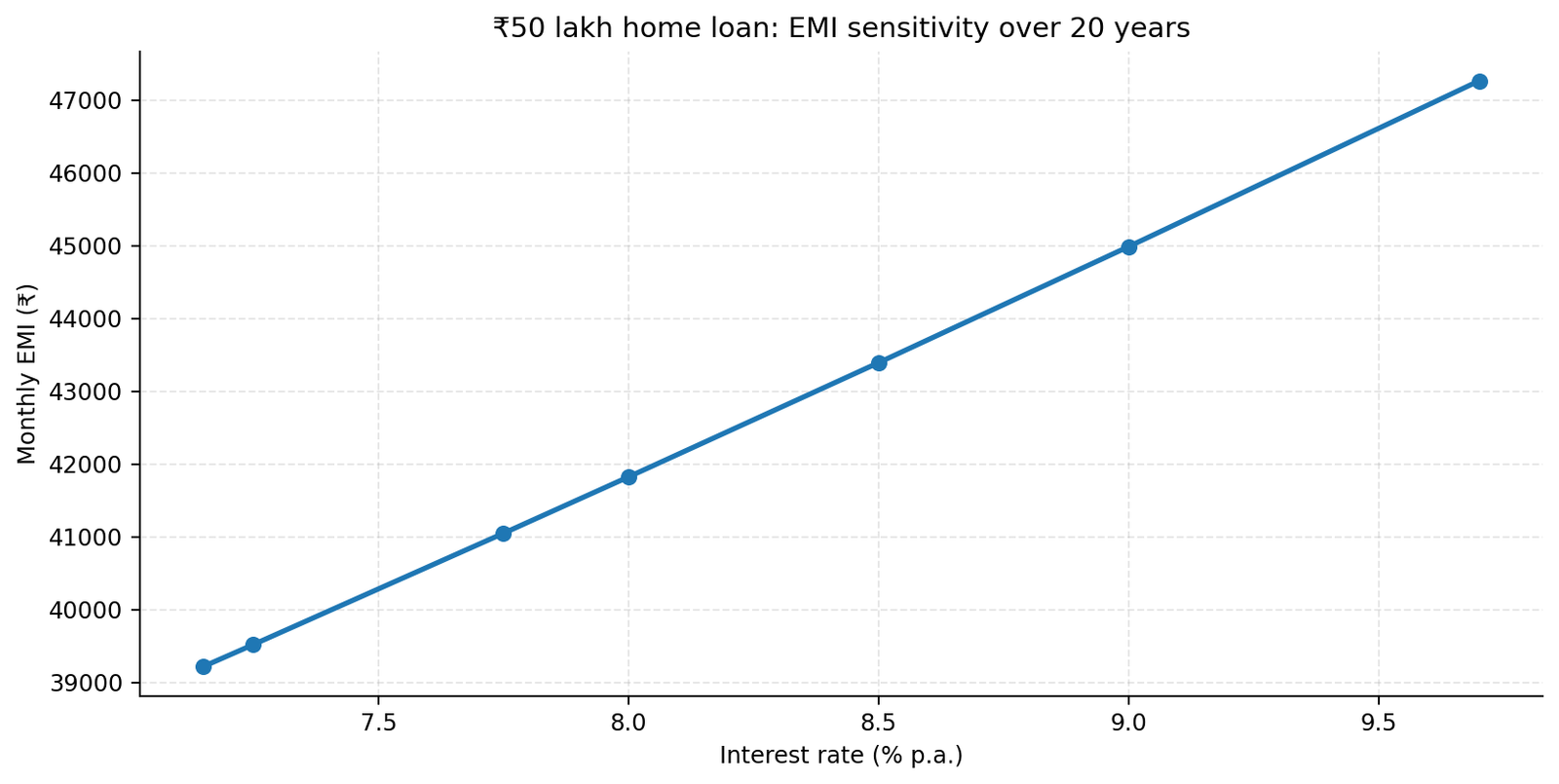
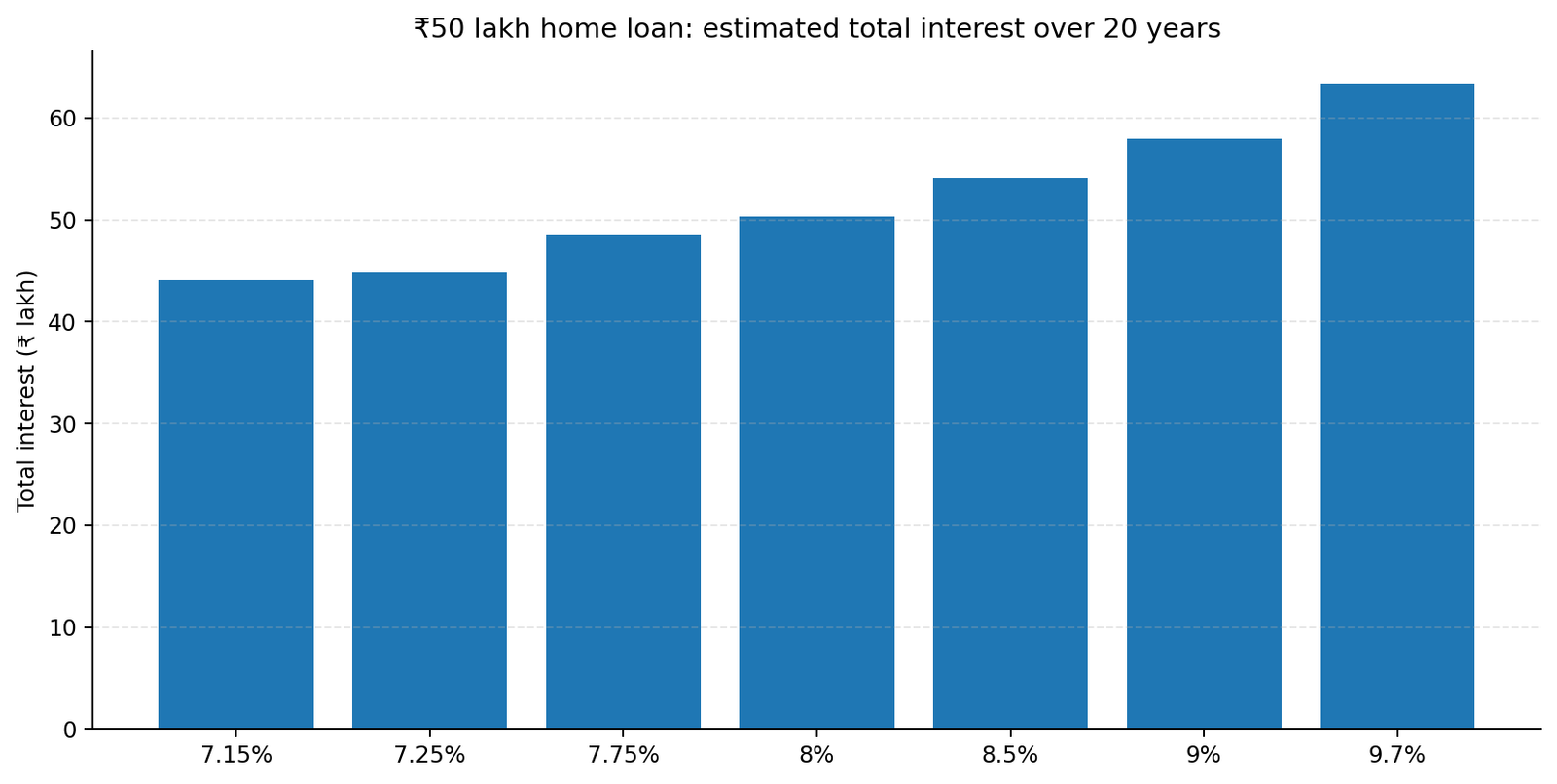
Take a ₹50 lakh home loan for 20 years. Compare 7.25% with 8.50%:
| Interest Rate | Approx. EMI | Approx. Total Interest | Approx. Total Repayment |
|---|---|---|---|
| 7.15% | ₹39,216 | ₹44.12 lakh | ₹94.12 lakh |
| 7.25% | ₹39,519 | ₹44.85 lakh | ₹94.85 lakh |
| 7.75% | ₹41,047 | ₹48.51 lakh | ₹98.51 lakh |
| 8% | ₹41,822 | ₹50.37 lakh | ₹100.37 lakh |
| 8.5% | ₹43,391 | ₹54.14 lakh | ₹104.14 lakh |
| 9% | ₹44,986 | ₹57.97 lakh | ₹107.97 lakh |
| 9.7% | ₹47,262 | ₹63.43 lakh | ₹113.43 lakh |
EMI sensitivity as interest rates rise
Total interest cost over 20 years
₹39,519EMI at 7.25%
₹43,391EMI at 8.50%
₹3,872Monthly difference
₹9.29 lakhApprox. extra outflow over 20 years
The monthly difference may not look dramatic. The long-term cost is where the impact becomes much clearer.
Credit Score Can Change the Rate More Than Borrowers Expect
LIC HFL’s published table makes this very easy to understand. For a ₹50 lakh home-loan example, the rate shown on its current table rises as the CIBIL band moves down:
| CIBIL Band | Published Rate for the Relevant Slab |
|---|---|
| 825+ | 7.15% |
| 800–824 | 7.35% |
| 775–799 | 7.5% |
| 750–774 | 7.6% |
| 725–749 | 7.8% |
| 700–724 | 8.1% |
| 600–699 | 8.9% |
| 201–599 | 9.7% |
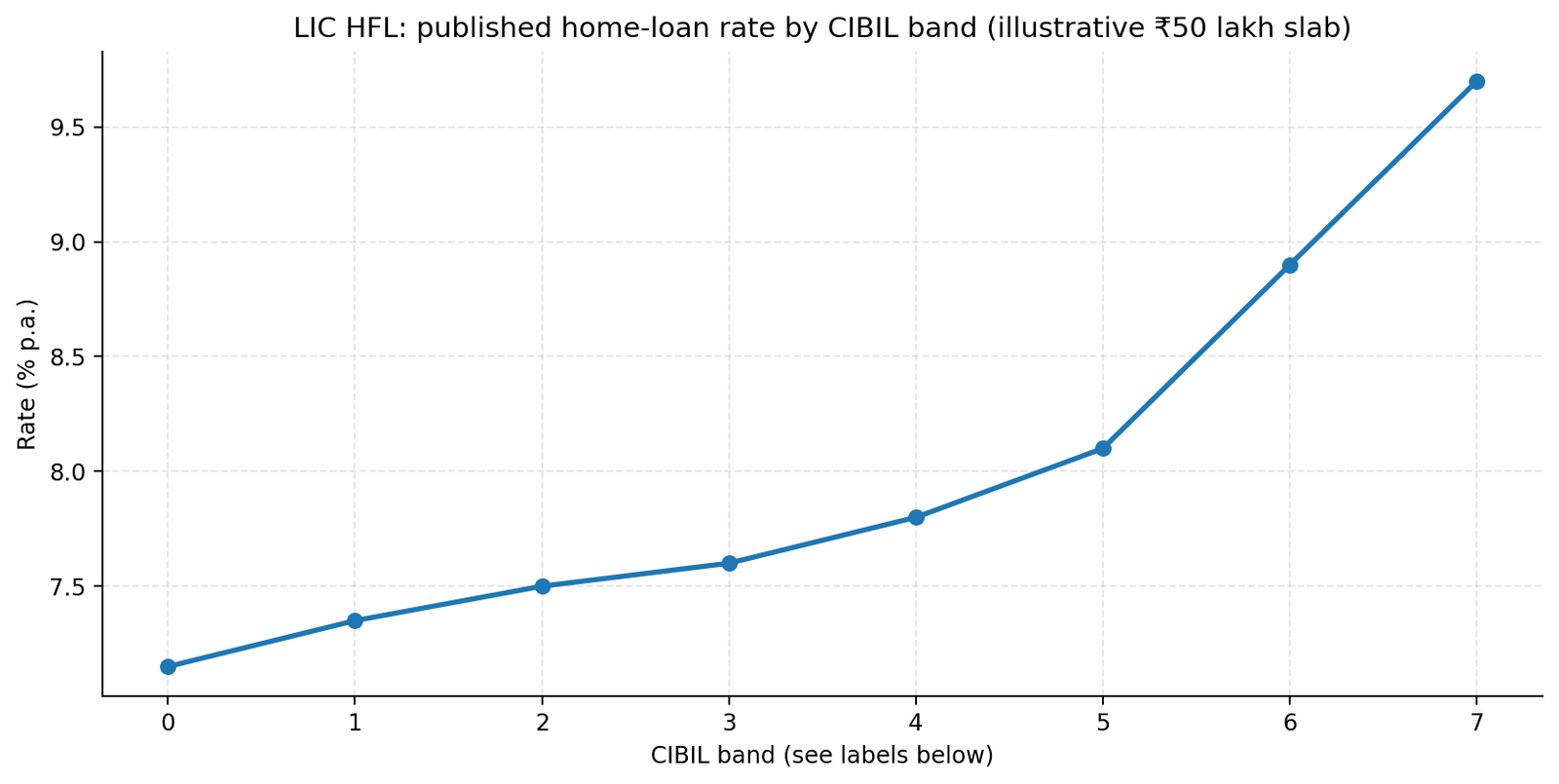
CIBIL labels left to right: 825+, 800–824, 775–799, 750–774, 725–749, 700–724, 600–699, 201–599.
PNB shows the same principle in a different way. For a floating home loan above ₹30 lakh with LTV ≤80%, its current table shows:
| CIBIL Band | PNB Published Floating Rate |
|---|---|
| 800+ | 7.25% |
| 750+ | 7.3% |
| 700–749 | 7.85% |
| 600–699 | 9.05% |
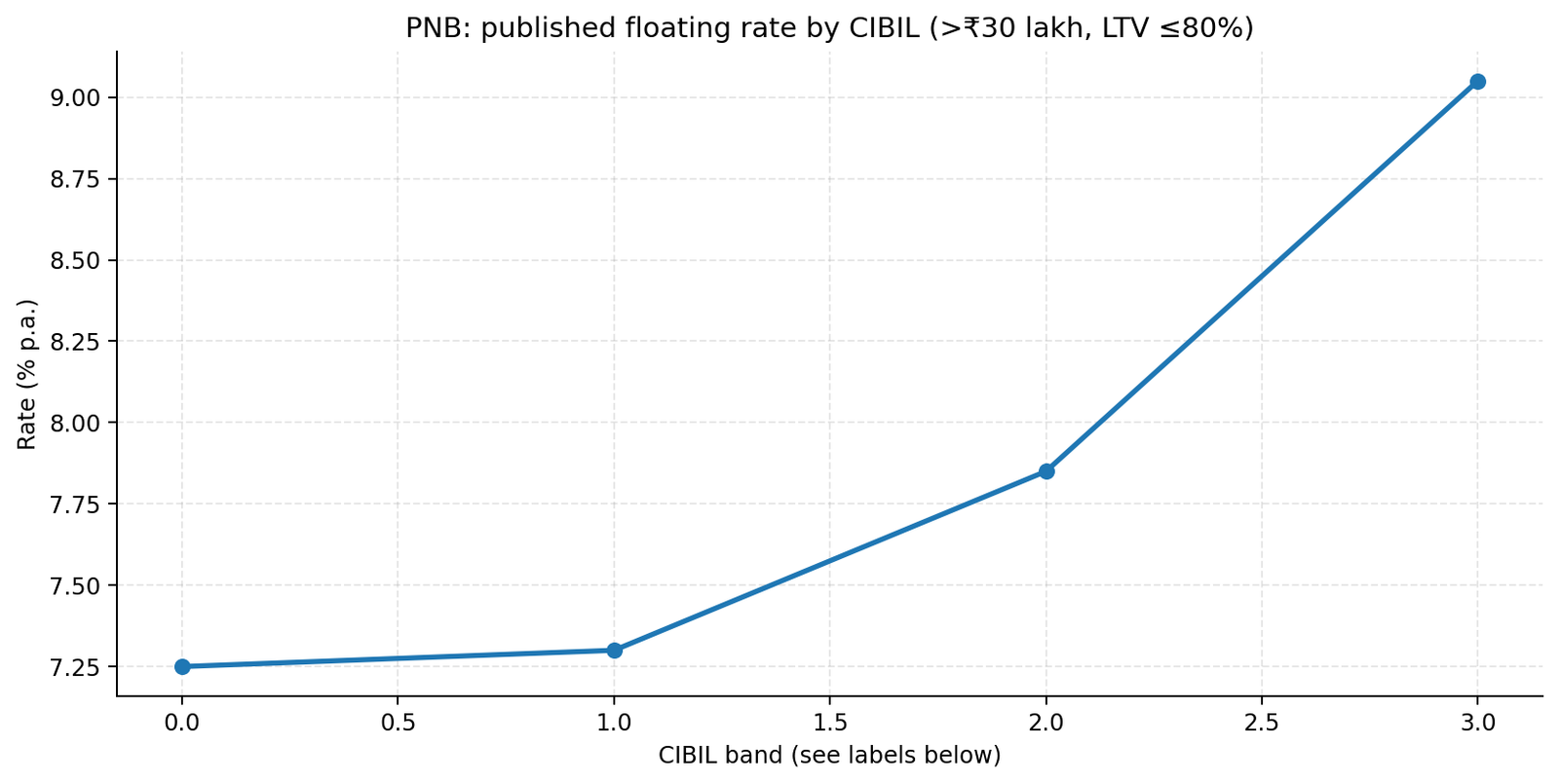
CIBIL labels left to right: 800+, 750+, 700–749, 600–699.
Borrower lesson
A difference in credit profile can move the rate by far more than the 0.10%–0.20% borrowers often spend weeks trying to negotiate. Improving the profile before applying can sometimes matter more than chasing one advertised offer.
Fixed vs Floating Home Loan Rates in 2026
| Floating Rate | Fixed Rate |
|---|---|
| Moves when the linked benchmark/reset changes | Gives more certainty for the fixed period |
| Can benefit if benchmark rates fall | May not benefit immediately if market rates fall |
| EMI, tenure or both may change depending on lender treatment | Read the expiry/reset clause carefully |
| Often benchmark-linked | May carry different pricing and conversion terms |
Ask these four questions before signing
Which benchmark is my loan linked to? What spread is being added? How often can the rate reset? If the rate rises, will my EMI increase, my tenure increase, or both?
How to Compare Two Home Loan Offers Properly
1. Final Sanctioned RateIgnore the marketing headline once the sanction is available
↓
2. Benchmark + SpreadUnderstand what can change later
↓
3. Processing & Other ChargesLegal, technical, admin and other applicable fees
↓
4. KFS / APRCompare the broader cost of borrowing
↓
5. Reset / Conversion / Prepayment TermsThink beyond year one
↓
6. Policy FitThe lender must suit your income, property and documentation profile
The Key Facts Statement Matters More Than the Advertisement
When the lender issues your formal offer, review the Key Facts Statement and sanction terms carefully. A borrower should understand not only the nominal interest rate but also the important fees, repayment terms and other costs that affect the total borrowing decision.
Do not compare 7.25% vs 7.50% in isolation.
Compare the total package: final rate, fees, reset method, prepayment terms, insurance/cross-sell costs if any, serviceability and your expected holding period.
How to Improve Your Chances of Getting a Better Rate
- 1 Review your credit report before making several formal applications.
- 2 Reduce avoidable high-cost debt or revolving balances where practical.
- 3 Keep salary credits, bank statements and income documents consistent and easy to verify.
- 4 Compare lenders whose policy actually fits your profile instead of applying everywhere.
- 5 Negotiate using a credible competing offer rather than only quoting an advertisement.
- 6 Compare total borrowing cost and KFS/APR—not just the nominal rate.
Should You Wait for Home Loan Rates to Fall?
Trying to perfectly time interest rates is difficult. Instead of asking whether rates may fall another 0.25%, ask whether the home and loan are affordable today and whether your finances remain comfortable if rates move against you later.
- 1 Is the EMI comfortable at the final sanctioned rate?
- 2 Can you handle a moderate rate increase?
- 3 Will you still have emergency savings after the down payment?
- 4 Is your credit profile ready?
- 5 Have you compared lenders that genuinely fit your profile?
Before You Apply: 8-Point Rate-Comparison Checklist
- 1 Verify the latest rate on the lender’s official website.
- 2 Ask for the rate applicable to your exact credit and income profile.
- 3 Check the loan amount and LTV assumptions behind the quote.
- 4 Compare the final sanctioned rate—not just the “starting from” rate.
- 5 Review all applicable processing, legal, technical and other charges.
- 6 Understand benchmark, spread and reset frequency.
- 7 Stress-test your EMI at a higher rate.
- 8 Choose the lender whose total cost and policy fit your situation.
Want to Compare Home Loan Options for Your Profile?
A rate table can tell you what lenders publish. It cannot tell you which options may actually fit your salary, existing EMIs, CIBIL profile, requested loan amount, property and documentation.
Compare Home Loan Options for My Profile
Start with your profile before making formal applications. Finstar Credit Solutions can help you understand the requirement, eligibility considerations, documentation and possible lending routes.
Frequently Asked Questions
What are current home loan interest rates in India in 2026?
As of 20 August 2026, selected official lender pages show rates beginning around the low-to-mid 7% range for certain strong profiles and special products, while profile-based and standard tables can run materially higher. There is no single universal rate.
Which bank has the lowest home loan interest rate in 2026?
There is no single lowest lender for every borrower. Bank of Baroda currently advertises a 7.20% starting rate, while PNB and SBI show 7.25% lower-end figures in their current published information. LIC HFL shows 7.15% for a specific top-CIBIL profile and slab. Your final eligible rate can be different.
What is SBI’s home loan rate in August 2026?
SBI’s current page shows 7.25% p.a. onwards, effective from 1 April 2026, with terms and conditions applying.
What is PNB’s home loan rate in August 2026?
PNB’s current table states home-loan ROI starting from 7.25% p.a. For the published example of a loan above ₹30 lakh with LTV ≤80%, the rate shown is 7.25% for CIBIL 800+, 7.30% for 750+, 7.85% for 700–749 and 9.05% for 600–699.
What is HDFC Bank’s home loan rate in 2026?
HDFC Bank’s current official rate page shows special housing-loan rates of 7.75%–13.20%, benchmarked to the policy repo rate of 5.25%. The actual rate depends on borrower and loan characteristics.
What are ICICI Bank’s home loan rates in August 2026?
ICICI’s special table currently shows 8.50% for the displayed 800 and 750–800 credit-score bands for salaried borrowers, while its standard table ranges from 8.50% to 9.80% depending on loan slab and borrower type. The page headline also advertises a lower starting figure, so confirm the exact promotional eligibility.
Does CIBIL score affect the home loan interest rate?
Yes. PNB, Axis, LIC HFL, ICICI and Bajaj Housing Finance all publish information showing that credit profile can materially influence rate or rate band.
What is the RBI repo rate in August 2026?
The RBI policy repo rate is 5.25% as of the latest current-rate information reviewed for this article.
Should I transfer my existing home loan if another lender offers a lower rate?
Only after comparing expected interest savings against transfer-related processing, legal/technical, conversion and other applicable costs, and considering your remaining tenure. A lower headline rate does not automatically make a balance transfer worthwhile.
Final Takeaway
Do not ask only:
“Which lender has the lowest home loan interest rate?”
Ask instead:
“What is the best rate I can realistically qualify for, and what will that loan cost me over the full tenure?”
The right home loan is a combination of rate, eligibility, total cost, property fit, documentation and repayment comfort.
Finstar Credit Solutions
Smart Credit. Simple Solutions. Better Futures.
Official Sources & Rate Verification
Rates checked: 20 August 2026. This article uses official RBI and lender pages rather than aggregator websites. Rates can change after publication, so always verify the lender’s current page and the final sanctioned offer.
- Reserve Bank of India — Current Policy Rates
- SBI — Home Loans Interest Rates (Current)
- Punjab National Bank — Retail Home Loan Rates
- Bank of Baroda — Home Loan
- HDFC Bank — Home Loan Interest Rates
- Axis Bank — Home Loan Interest Rates & Charges
- ICICI Bank — Home Loan Interest Rates
- Bajaj Housing Finance — Home Loan Interest Rates
- LIC Housing Finance — Home Loan Interest Rates
- Canara Bank — Retail Loan Interest Rate Range
Disclaimer: Interest-rate information in this article is based on selected official lender pages checked on 20 August 2026 and may change without notice. Some figures are advertised starting rates, some are profile-specific rates, some are standard-rate tables and some are contracted-loan ranges; they should not be treated as directly comparable guaranteed offers. EMI and total-interest examples are mathematical illustrations only. Finstar Credit Solutions is an independent loan advisory/facilitation service and is not a bank, NBFC or lender. Final eligibility, sanction, rate, fees and terms are determined by the respective lender.