
Last reviewed: 27 August 2026. If you are searching for the lowest home loan interest rate in India, the most important thing to know is this: the lowest rate advertised on a website is not automatically the rate you will get. Your final home-loan pricing can change with credit score, income, employment type, loan amount, loan-to-value, property, relationship with the lender, product variant and internal underwriting.
This guide separates advertised starting rates, profile-based actual rates, and the all-in borrowing cost. It also explains what RBI rules mean for floating-rate borrowers, how to read a Key Facts Statement (KFS), when a balance transfer makes sense, and exactly how to negotiate for a lower rate.
Quick Answer: What Is the Lowest Home Loan Interest Rate in India in 2026?
| Lender / Product | Published rate reference | Important qualification | Official source |
|---|---|---|---|
| Central Bank of India – Cent Grih Lakshmi | 7%–8.25% | Specific product; CIC score and terms apply | https://centralbank.bank.in/en/retail-scheme-interest |
| Bank of Maharashtra – Maha Super Housing | 7.1% salaried / 7.2% non-salaried at CIBIL 800+ | RLLR-linked; profile slabs apply | https://bankofmaharashtra.bank.in/retail-interest-rates |
| Canara Bank – Housing Loan | 7.15%–10% | Contracted range; mean rate shown by bank | https://www.canarabank.bank.in/pages/interest-rate-range-on-loans |
| Bank of Baroda – Home Loan | 7.2% onwards | Starting rate; conditions apply | https://bankofbaroda.bank.in/loans/home-loan |
| State Bank of India – Home Loan | 7.25% onwards | Published w.e.f. 01.04.2026 | https://sbi.bank.in/web/interest-rates/interest-rates/loan-schemes-interest-rates/home-loans-interest-rates-current |
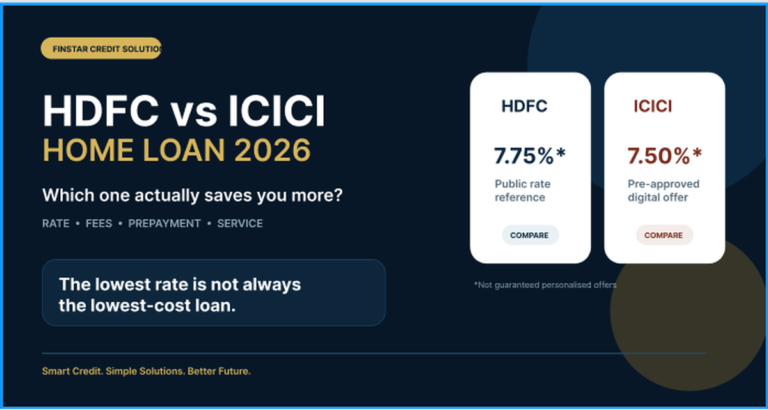
| HDFC Bank – Housing (FY27 Q1 observed IRR) | Min 7.1%, Avg 7.35%, Max 12% | Historical/quarterly rates offered to customers; not a promise of today's rate | https://homeloans.hdfc.bank.in/ps/home-loans-in-india |
| ICICI Bank – Digital pre-approved journey | 7.55%* | Pre-approved digital customers; bank's standard/special tables may be higher | https://www.icici.bank.in/personal-banking/loans/home-loan/interest-rates |
Why Two People Can Get Different Home Loan Rates From the Same Bank
How Much Does a 0.25%, 0.50% or 1% Rate Difference Actually Cost?
A small percentage looks harmless until you multiply it across 15–30 years. The following example uses a ₹50 lakh loan for 20 years with no prepayment. It is purely mathematical and does not predict a lender quote.
| Rate | Approx. EMI | Approx. total interest | Total repayment |
|---|---|---|---|
| 7% | ₹38,765 | ₹4,303,587 | ₹9,303,587 |
| 7.1% | ₹39,066 | ₹4,375,754 | ₹9,375,754 |
| 7.25% | ₹39,519 | ₹4,484,512 | ₹9,484,512 |
| 7.5% | ₹40,280 | ₹4,667,118 | ₹9,667,118 |
| 7.75% | ₹41,047 | ₹4,851,383 | ₹9,851,383 |
| 8% | ₹41,822 | ₹5,037,281 | ₹10,037,281 |
How to Qualify for the Lowest Possible Home Loan Rate
- 1Review your latest credit report for errors, overdue amounts and high utilisation.
- 2Avoid unnecessary new unsecured-loan or card applications immediately before the home-loan process.
- 3Calculate your current EMI obligations and debt-to-income pressure.
- 4Keep 6–12 months of banking/income records organised.
- 5Decide the maximum comfortable EMI—not only the maximum eligible EMI.
- 6Prepare the property papers the lender is likely to need.
- 7Ask every lender for a written, profile-specific rate quotation.
| Profile signal | What lender may infer | What you should ask |
|---|---|---|
| CIBIL 800+ / clean repayment | Lower perceived credit risk | Is there a best-score pricing slab? |
| Stable salaried income | Predictable cash flow | Is there a salary-account or employer-category concession? |
| Low existing EMIs | More repayment headroom | Can the spread be reduced? |
| Higher own contribution | Lower LTV / lender risk | Does a lower LTV improve pricing? |
| Strong competing offer | Real price competition | Can you match the rate and waive/reduce fees? |
| Existing customer | Relationship value | Any pre-approved or relationship-based pricing? |
Try Finstar’s free loan tools
Estimate your EMI or share a few basic details for a more relevant first conversation.
RBI Rules That Matter When You Are Chasing a Lower Home Loan Rate
- 1Annual Percentage Rate / all-in annualised cost where applicable.
- 2Interest rate and whether it is fixed or floating.
- 3Benchmark and spread / pricing methodology where shown.
- 4Loan amount and tenure.
- 5EMI / repayment schedule.
- 6Processing and third-party charges.
- 7Penal charges and delayed-payment implications.
- 8Prepayment / foreclosure conditions where applicable.
| Offer | Interest rate | Fees / linked costs | What to compare |
|---|---|---|---|
| Bank A | 7.2% | Higher processing + bundled costs | All-in APR / KFS |
| Bank B | 7.3% | Lower processing + clean terms | All-in APR / KFS |
| Bank C | 7.25% | Rate-conversion fee / service conditions | Lifetime cost + flexibility |
Prepayment: One of the Biggest Advantages of a Floating Home Loan
| Question | Why it matters |
|---|---|
| Can I part-prepay online? | A convenient process makes disciplined prepayment easier. |
| Is there a minimum part-payment amount? | Small monthly extras may otherwise be inconvenient. |
| Does prepayment reduce tenure or EMI? | Tenure reduction usually saves more interest if EMI remains affordable. |
| How quickly is principal adjusted? | You want the extra amount credited to principal correctly. |
| Can I download a revised amortisation schedule? | You should be able to verify the effect. |
Should You Choose a PSU Bank or a Private Bank for the Lowest Rate?
| Dimension | Public-sector bank tendency | Private-bank tendency |
|---|---|---|
| Starting rates | Often very competitive at the low end | Can be competitive for selected profiles / campaigns |
| Processing speed | Can vary by branch and documentation | Often positioned around faster digital processing |
| Negotiation | May be slab/policy driven | Relationship / pre-approved pricing can matter |
| Service model | Branch/loan-centre dependent | More app/RM-led in many journeys |
| Best for | Borrowers prioritising price and transparent policy fit | Borrowers valuing speed, digital convenience or relationship pricing |
What Fresh 2026 Market Comparisons Are Showing
Fresh August 2026 media comparisons report rates beginning around 7% for selected public-sector products/profiles. The Economic Times reported that home-loan rates can start at 7% and stressed that advertised rates vary by borrower profile. A recent Indian Express comparison similarly highlighted 7% starting points for selected PSU lenders. These reports are helpful for market scanning—but your decision should still be anchored to the lender's own current rate card and your written personalised quote.
| Priority | Source | Best use |
|---|---|---|
| 1 | Your sanction letter + KFS / MITC | Final contractual decision |
| 2 | Official bank/HFC rate page | Current public pricing and product rules |
| 3 | RBI / NHB / MoHUA official pages | Regulatory and scheme rules |
| 4 | Reputed financial media | Market-wide comparison and recent changes |
| 5 | Forums / social comments | Service issues and questions to investigate |
Can PMAY-U 2.0 Reduce Your Effective Housing Cost?
- 1Current household-income eligibility.
- 2Property / ownership conditions.
- 3Eligible loan and house value limits.
- 4Whether the lender is a participating Primary Lending Institution.
- 5Application and beneficiary-identification requirements.
- 6Latest ISS guidelines and any amendments.
When Is a Home Loan Balance Transfer Worth It?
| Item | Illustrative amount |
|---|---|
| Monthly saving after transfer | ₹2,500 |
| Total switching cost | ₹50,000 |
| Simple break-even | 20 months |
| Interpretation | More attractive if you expect to keep the loan well beyond break-even |
Try Finstar’s free loan tools
Estimate your EMI or share a few basic details for a more relevant first conversation.
7 Questions to Ask Every Bank Before You Apply
- 1What exact interest rate applies to my profile today?
- 2What benchmark is the loan linked to, and what spread are you adding?
- 3How often can the rate reset, and when will my first reset happen?
- 4What is the APR / total all-in cost shown in the KFS?
- 5List every processing, legal, technical, mortgage, valuation and service charge.
- 6What is the online part-prepayment process and how does it affect tenure/EMI?
- 7Are any discounts conditional on insurance, salary account, property type, co-applicant or other products?
Try Finstar’s free loan tools
Estimate your EMI or share a few basic details for a more relevant first conversation.
Frequently Asked Questions
Which bank has the lowest home loan interest rate in India in 2026?
There is no single bank that is lowest for every borrower. In August 2026, selected public-sector products/profile slabs are appearing around 7.00%–7.20%, while actual rates depend on borrower and property profile. Compare official rate cards and obtain written personalised quotes.
Can I really get a home loan at 7%?
A rate around 7% can be available in specific lender/product/profile combinations, but it is not a universal rate. Excellent credit, stable income, appropriate LTV and scheme eligibility may help, but the lender's current underwriting decides the offer.
Does a CIBIL score of 800 guarantee the lowest rate?
No. A strong score helps, but lenders also consider income, obligations, employment type, loan amount, property, LTV, product and internal policy.
Should I choose the bank with the lowest starting rate?
Not automatically. Compare the rate applicable to you, benchmark/spread, APR/KFS, fees, prepayment process, reset rules, service and any conditions attached to the discount.
What is the RBI repo rate in August 2026?
RBI's official website showed the policy repo rate at 5.25% after the August 2026 MPC.
Will a repo-rate cut reduce my EMI automatically?
It depends on whether your loan is linked to the repo/external benchmark, your reset schedule and lender implementation. The effect may be reflected through EMI, tenure or other permitted reset options.
Can a bank charge foreclosure fees on a floating home loan?
RBI has prohibited foreclosure/prepayment penalties on qualifying floating-rate term loans to individual borrowers, with related protections also applicable to HFCs under NHB directions. Check the exact loan category and current written terms.
Is balance transfer always beneficial when another bank offers a lower rate?
No. Compare future interest saving against processing, legal, valuation, mortgage/stamp/CERSAI and other switching costs, plus service and prepayment convenience. Calculate the break-even period.
Is fixed or floating better for the lowest rate?
The better choice depends on pricing, interest-rate outlook, certainty preference and the contract. Floating rates are usually benchmark-linked and can move; fixed rates offer stability but may be priced differently and have different prepayment rules.
How many banks should I compare before taking a home loan?
A practical approach is to obtain 3–5 serious written quotes on the same loan amount and tenure, including at least one strong PSU option and one or more private-bank options that fit your service needs.
Authoritative Sources & Backlinks
For readers—and for transparent sourcing—this article should link contextually to the following authorities and lender pages, not hide them only at the bottom.
1. Reserve Bank of India – current policy rates: https://www.rbi.org.in/
2. RBI – Key Facts Statement for Loans & Advances / lending directions: https://www.rbi.org.in/
3. RBI – floating-rate reset / borrower protection directions: https://www.rbi.org.in/
4. National Housing Bank – HFC borrower / prepayment guidance: https://www.nhb.org.in/
5. PMAY-U 2.0 – Ministry of Housing & Urban Affairs: https://pmay-urban.gov.in/pmay-u-2.0-guidelines
6. SBI – official home-loan interest rates: https://sbi.bank.in/web/interest-rates/interest-rates/loan-schemes-interest-rates/home-loans-interest-rates-current
7. Bank of Maharashtra – retail interest rates: https://bankofmaharashtra.bank.in/retail-interest-rates
8. Canara Bank – interest-rate range on loans: https://www.canarabank.bank.in/pages/interest-rate-range-on-loans
9. Bank of Baroda – official home-loan page: https://bankofbaroda.bank.in/loans/home-loan
10. Central Bank of India – retail scheme interest rates: https://centralbank.bank.in/en/retail-scheme-interest
11. HDFC Bank – home loans / rates offered to customers: https://homeloans.hdfc.bank.in/ps/home-loans-in-india
12. ICICI Bank – official home-loan interest rates: https://www.icici.bank.in/personal-banking/loans/home-loan/interest-rates
13. TransUnion CIBIL – home-loan education: https://www.cibil.com/loans-home
Final Answer: How to Get the Lowest Home Loan Interest Rate
If one lender advertises 7.10% and another 7.25%, do not decide in 30 seconds. First confirm whether you qualify for 7.10%, what charges or conditions come with it, how the floating rate will reset, and how easy it will be to prepay. That is how a borrower converts a low headline rate into a genuinely low-cost home loan.
Finstar Credit Solutions — Smart Credit. Simple Solutions. Better Future.
Disclaimer: This article is for general educational and comparison purposes only and does not constitute a loan offer, sanction, financial, legal, tax or investment advice. Interest rates and schemes can change without notice and may differ by credit score, borrower segment, employment profile, loan amount, LTV, property, geography, lender policy and channel. Rates in this article were reviewed from official lender pages and recent public sources around 27 August 2026; readers must re-check the lender's current official rate card and obtain a written personalised quotation, sanction letter and Key Facts Statement before acting. Forum/social-media observations are anecdotal and are included only to identify issues borrowers may wish to verify. EMI examples are mathematical illustrations. PMAY-U 2.0 eligibility and subsidy terms must be verified on the official MoHUA portal. Finstar Credit Solutions is an independent loan advisory/facilitation service and is not a bank, NBFC, RBI or government body.