SEO-OPTIMIZED BLOG POST
Increase Home Loan Tenure, Lower EMI & Prepay Every Month: Does It Really Save Interest?
A numbers-first guide to the “longer tenure + monthly prepayment” strategy
Suggested featured image text: “Lower EMI + Extra Prepayment: Smart Move or Trap?”
Last reviewed: 24 August 2026 | India
Increase Home Loan Tenure, Lower EMI & Prepay Every Month: Does It Really Save Interest?
Imagine this: you have only 5 years left on your home loan, but the EMI feels heavy. You consider stretching the remaining tenure to 15 or 20 years so the compulsory EMI drops sharply. Then, every month, you plan to pay an additional amount directly toward principal. The idea sounds clever: lower compulsory EMI, more flexibility, and perhaps lower interest too.
But does it actually save money? The answer depends on one number that most borrowers overlook: your actual total monthly outflow after the tenure is extended.
What you will learn
Why a lower EMI can actually increase total interest
A ₹50 lakh worked example: 5 years vs 15 years vs 20 years
What happens when you add monthly principal prepayments
The “same outflow” rule that makes the maths easy
When this strategy is useful — and when it can backfire
Current RBI rules you should know before prepaying
A practical borrower checklist and FAQs
1. First, understand what a longer tenure really changes
Your EMI is a scheduled payment. When the same loan balance is spread over more months, the compulsory EMI becomes smaller. That helps monthly cash flow — but it also keeps the principal outstanding for longer unless you voluntarily pay extra.
Interest is charged on the outstanding principal. So the faster the principal reduces, the less future interest has a chance to accumulate. This is why the repayment path matters more than the tenure label alone.
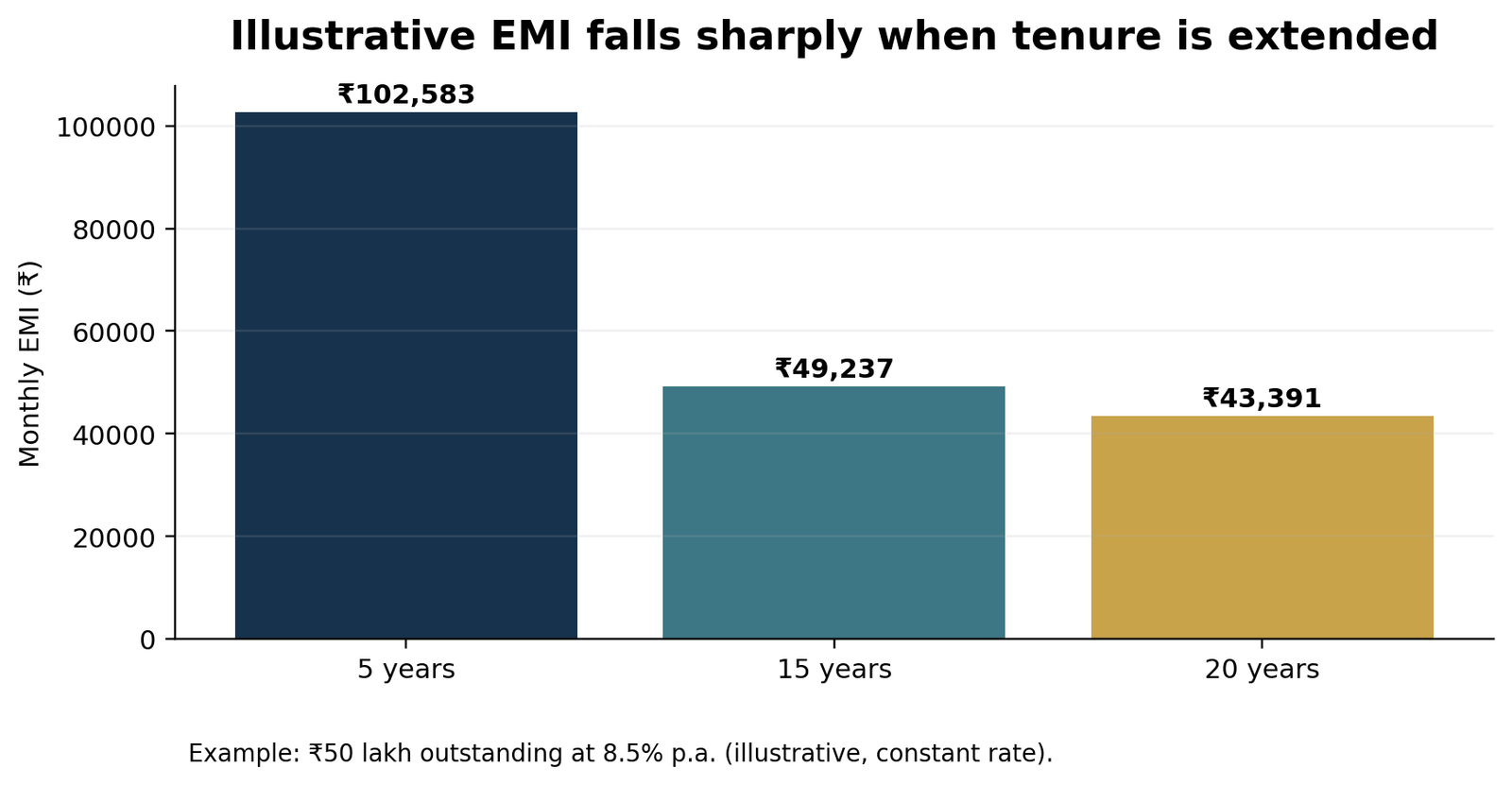
Visual 1: Lower EMI creates breathing room — but that breathing room must be used wisely.
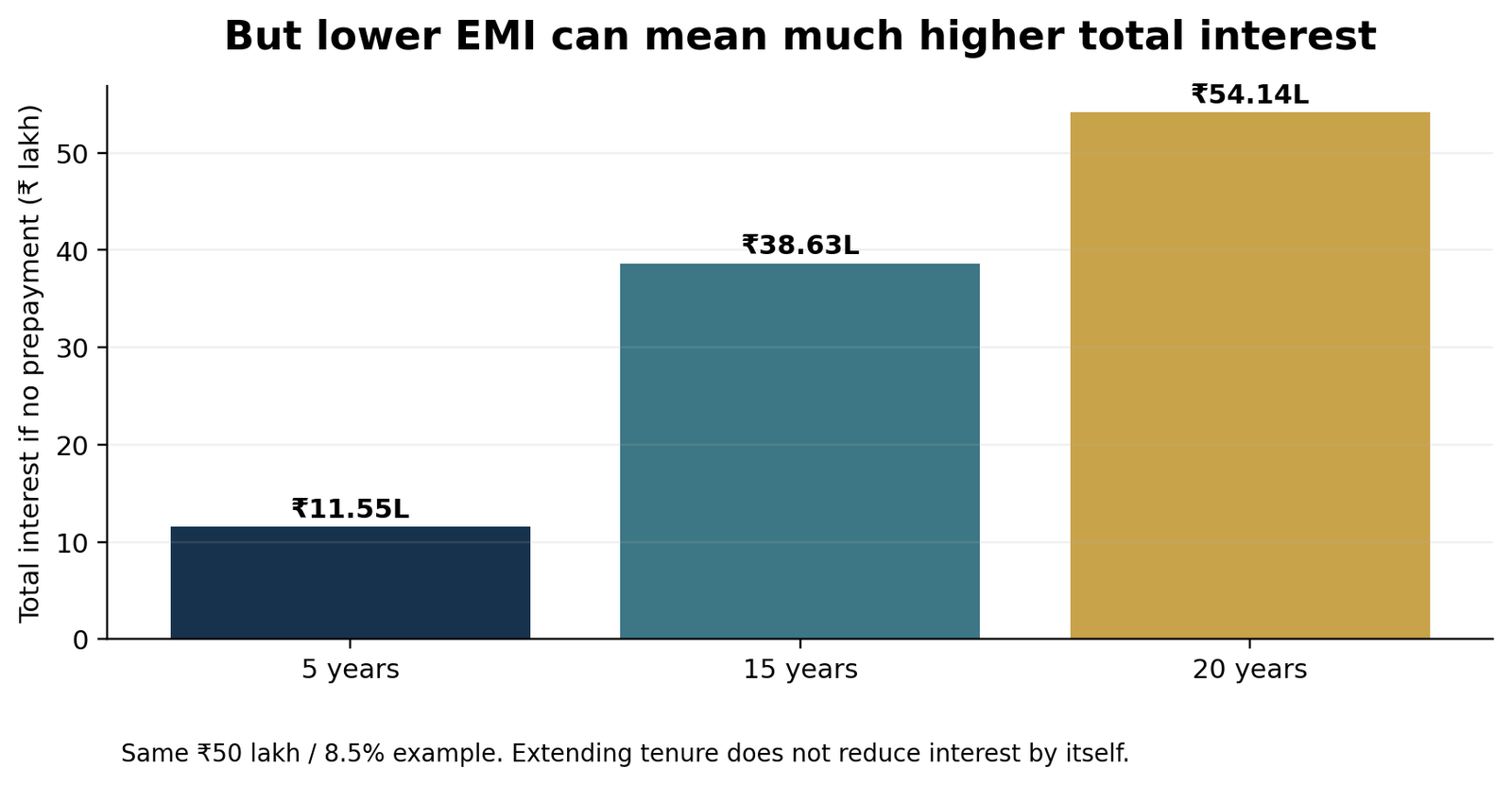
Visual 2: If you simply extend the tenure and do nothing else, the total interest can rise dramatically.
2. Worked example: ₹50 lakh outstanding at 8.5%
To isolate the strategy, let us use one simple illustrative case. The 8.5% rate below is an example for calculation, not a claim about the current market rate. We assume the rate does not change, there are no processing/restructuring costs, and every extra payment is credited to principal immediately.
| Remaining tenure | Approx. EMI | Total interest if no prepayment | What changes? |
|---|---|---|---|
| 5 years | ₹1,02,583 | ₹11.55 lakh | High compulsory EMI; fastest scheduled repayment |
| 15 years | ₹49,237 | ₹38.63 lakh | EMI falls ~52%, but interest rises if you only pay EMI |
| 20 years | ₹43,391 | ₹54.14 lakh | Lowest EMI; highest interest if you only pay EMI |
The trap is obvious once you see the totals: a 20-year EMI looks comfortable, but if you stop at ₹43,391 per month, the illustrative interest bill is about ₹42.59 lakh higher than the 5-year schedule.
3. Now add monthly principal prepayments
This is where the strategy becomes interesting. Suppose you extend the loan to 20 years, bringing the EMI to about ₹43,391. What if you then add money toward principal every month?
| 20-year contract: monthly plan | Total monthly outflow | Approx. payoff | Approx. total interest | Vs original 5-year plan |
|---|---|---|---|---|
| EMI only | ₹43,391 | 240 months | ₹54.14L | ₹42.59L more interest |
| EMI + ₹30,000 | ₹73,391 | 94 months | ₹18.51L | ₹6.96L more interest |
| EMI + ~₹59,192 | ₹1,02,583 | 60 months | ₹11.55L | Roughly the same |
| EMI + ₹70,000 | ₹1,13,391 | 54 months | ₹10.16L | ~₹1.39L less interest |
4. The “same monthly outflow” rule
Try Finstar’s free loan tools
Estimate your EMI or share a few basic details for a more relevant first conversation.
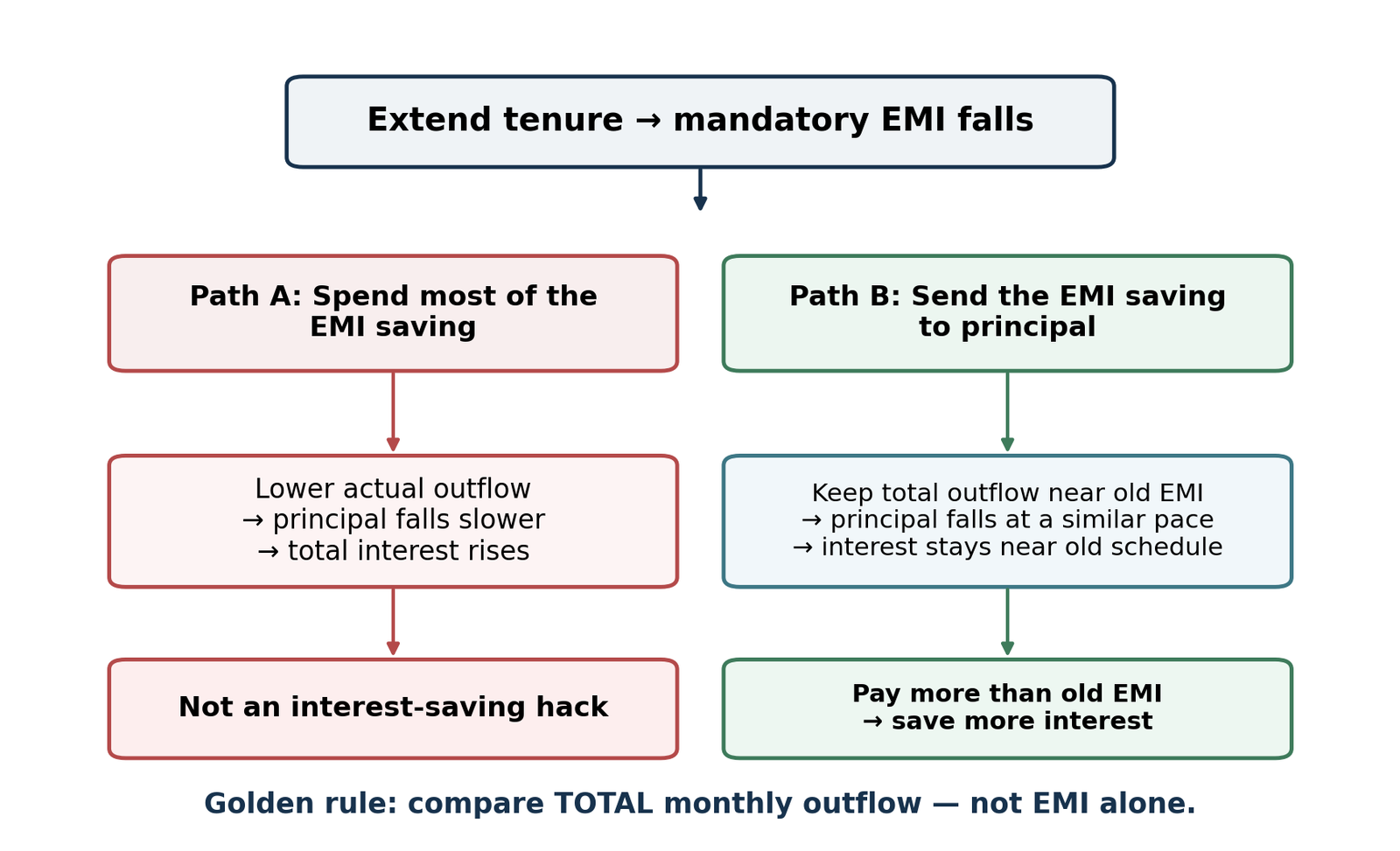
Here is the cleanest way to understand the strategy: if the interest rate is the same and the lender applies every extra rupee to principal immediately, then two loans with the same opening balance and the same total monthly payment will follow essentially the same amortisation path — even if one contract says 5 years and the other says 20 years.
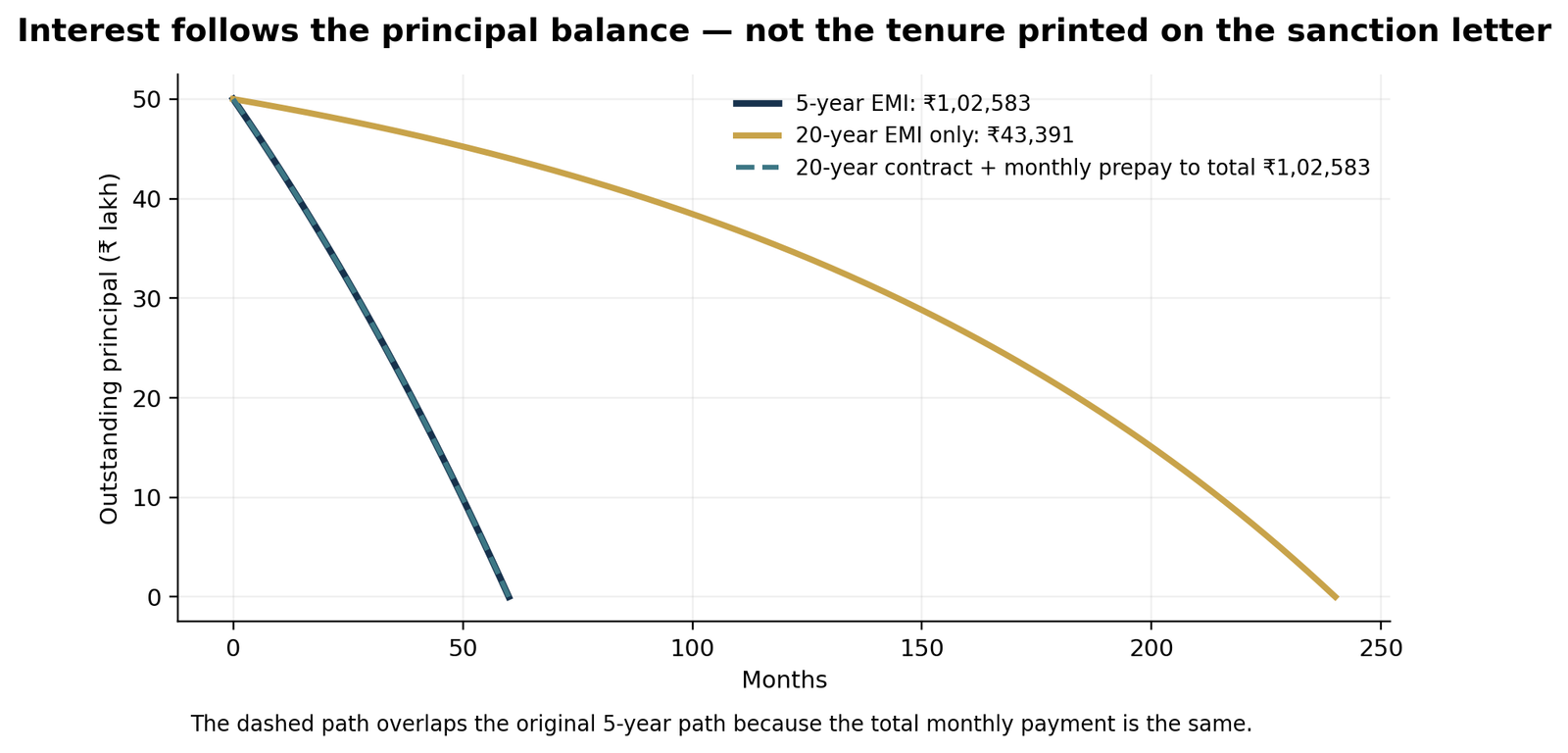
Visual 3: The 20-year contract plus disciplined prepayment can mathematically behave like the 5-year loan.
So what do you gain by extending tenure if the interest is the same? You gain optionality. Your compulsory EMI might be only ₹43,391 instead of ₹1,02,583. In a difficult month, the lower contractual EMI gives breathing room. In normal months, you voluntarily restore the higher payment through prepayment.
5. Why earlier principal payments are so powerful
Think of every prepayment as permanently removing a small piece of principal from future interest calculations. A prepayment made today can reduce interest for every remaining month. The same amount paid years later has fewer months left in which to generate savings.
That leads to a practical rule: if your goal is to minimise interest, make affordable principal payments as early and as consistently as possible. Where your lender gives a choice after part-prepayment, keeping the EMI broadly unchanged and reducing the remaining tenure will generally accelerate debt reduction more than simply lowering the EMI again.
What if you choose 15 years instead of 20?
At 15 years, the illustrative EMI is about ₹49,237. If you add ₹20,000 every month, your total outflow becomes about ₹69,237. The loan would finish in roughly 102 months (about 8.5 years), with about ₹20.28 lakh of interest. That is far better than paying the 15-year EMI alone, but it is still more interest than the original 5-year schedule because the total monthly outflow remains lower.
6. When extending tenure + prepaying can make sense
Your income is variable.
A lower compulsory EMI can reduce default risk during weak months while you prepay aggressively during stronger months.
You want emergency cash-flow protection.
The difference between the old EMI and the new EMI acts as optional breathing room — provided you do not routinely spend it.
Your lender allows easy principal prepayments.
The strategy works best when payments are credited quickly to principal and charges or operational restrictions do not erase the benefit.
You are highly disciplined.
This is a behaviour-dependent strategy. An automatic monthly transfer toward principal can be more reliable than depending on leftover cash at month-end.
You want flexibility without giving up your old repayment pace.
A longer contractual tenure can provide a lower minimum payment while your voluntary outflow mimics the old schedule.
7. When the strategy can backfire
You are likely to spend the EMI saving.
If the lower EMI becomes lifestyle spending, the loan stays outstanding longer and interest can rise sharply.
The lender reprices the loan or charges for the change.
A tenure change, rate conversion, restructuring, or fixed-rate prepayment may involve conditions or costs. Compare the all-in cost before changing anything.
The longer tenure pushes debt too far into retirement.
A lower EMI is not automatically safer if it creates a very long debt horizon.
You have expensive debt elsewhere.
It may be more valuable to eliminate higher-cost unsecured debt first rather than over-prepaying a lower-rate secured loan.
You do not maintain an emergency fund.
Using every spare rupee to prepay can leave you liquidity-poor. A sound repayment plan should not make you financially fragile.
8. What RBI rules say about EMI resets and prepayment
RBI’s framework on floating-rate EMI-based personal loans requires regulated entities to communicate the impact of interest-rate resets and provide borrowers with options that can include increasing EMI, extending tenure, a combination of the two, and part/full prepayment. Read RBI’s Master Direction on reset of floating interest rates.
RBI’s updated FAQ also states that borrowers should receive information on principal and interest recovered, EMI, number of instalments left and the annualised interest rate/APR in periodic statements. Read the RBI FAQ.
Separately, the Reserve Bank of India (Pre-payment Charges on Loans) Directions, 2025 apply to loans and advances sanctioned or renewed on or after 1 January 2026. Among other provisions, eligible floating-rate loans granted to individuals for non-business purposes cannot carry prepayment charges; the directions also address disclosure of prepayment charges and other cases. Read RBI Circular RBI/2025-26/64.
RBI’s consumer guidance on home loans also advises borrowers to compare loan term, fixed vs floating rate, fees and prepayment conditions — not merely the EMI. Read RBI’s home-loan consumer guidance.
Check the KFS / loan documents before acting
RBI’s Key Facts Statement (KFS) framework is designed to give retail and MSME borrowers a simpler view of key loan facts and the all-in cost of borrowing. Use the KFS, sanction letter and latest loan statement to confirm your interest rate, APR/charges and repayment conditions. RBI reference on KFS and all-in cost disclosure.
9. A safer way to execute the strategy
- Get the lender’s revised numbers in writing. Ask for the proposed EMI, revised tenure, current rate, any conversion/restructuring fee and any prepayment restrictions.
- Decide your target total monthly outflow. Do not start with “How low can my EMI go?” Start with “How much can I safely pay each month on average?”
- Set the extra payment to principal, not simply as an advance EMI. Confirm how your lender will account for it and verify the outstanding principal after the payment posts.
- Automate the discipline. If your plan is to maintain the old EMI outflow, schedule the extra principal transfer soon after the regular EMI.
- Prefer tenure reduction when your goal is interest saving. Where the lender offers the choice after a part-prepayment, reducing tenure while keeping EMI higher usually preserves faster principal reduction.
- Recalculate after every rate reset or major lump-sum payment. Floating rates can change the math. A strategy built at 8.5% should not be blindly followed if the rate later moves.
- Protect liquidity. Keep an emergency reserve and adequate insurance before committing every spare rupee to the loan.
10. Which option is best?
| Approach | Mandatory EMI | Cash-flow flexibility | Interest outcome | Behaviour risk |
|---|---|---|---|---|
| Keep 5-year tenure | High | Low | Lowest among plans with no extra payment | Low |
| Extend to 20 years; pay EMI only | Low | High | Highest in our example | Medium |
| Extend to 20 years; total payment = old EMI | Low contractual EMI | High | Roughly same as old 5-year path | High |
| Extend to 20 years; total payment > old EMI | Low contractual EMI | High | Can beat old 5-year interest | High |
11. Myth vs reality
12. Shareable takeaways
“A longer tenure lowers your compulsory EMI. Only faster principal repayment lowers your interest.”
“Compare total monthly outflow, not EMI alone.”
“A 20-year loan can behave like a 5-year loan if you actually pay it like a 5-year loan.”
“Flexibility is the benefit. Discipline is the price.”
13. Frequently asked questions
Will increasing my home-loan tenure automatically reduce total interest?
No. It normally reduces the scheduled EMI but increases total interest if you only pay the lower EMI. Interest falls only when principal is repaid faster.
If I extend from 5 years to 20 years but keep paying the old EMI amount, what happens?
Under the same interest rate and immediate principal credit, the repayment path should be roughly the same as the original 5-year plan. The contractual minimum is lower, but your actual payment behaviour is still that of a 5-year loan.
Can I save more interest after extending the tenure?
Yes, if your actual total payment exceeds the old repayment pace or if you make meaningful principal payments earlier. The tenure extension itself is not the source of the saving.
Is monthly prepayment better than one annual lump sum?
If the total amount is the same, earlier principal reduction generally saves more interest because the balance becomes lower sooner. However, lender processing rules may affect timing and minimum amounts.
Should I reduce EMI or tenure after part-prepayment?
If your priority is interest saving and cash flow permits, reducing the remaining tenure while maintaining a higher EMI generally accelerates principal repayment. If monthly affordability is the priority, EMI reduction may be useful.
Are prepayment charges allowed on floating-rate home loans?
RBI rules restrict prepayment charges in specified floating-rate loans, including eligible non-business loans to individuals. The exact applicability depends on the loan type, lender and sanction/renewal date, so check your current documents and lender policy.
Is this strategy suitable for everyone?
No. It works best for disciplined borrowers who value a lower compulsory EMI but can still make regular principal payments. If the EMI saving is likely to be spent, the strategy can become much more expensive.
Final verdict: smart flexibility — not a magic interest hack
Increasing a home-loan tenure from 5 years to 15 or 20 years can be a sensible cash-flow strategy, but only if you understand what it is doing. The lower contractual EMI gives you flexibility. The monthly principal prepayments determine whether you preserve, worsen or improve your total interest cost.
If your total monthly payment after the change is lower than your current 5-year EMI, expect the loan to remain outstanding longer and, all else equal, cost more interest. If you keep total outflow around the old EMI, you can roughly preserve the old repayment path while enjoying a lower mandatory payment. If you consistently pay more than the old EMI, you can potentially finish earlier and save additional interest.
Need help comparing the numbers?
Before changing your tenure, ask for a side-by-side calculation of your current schedule, proposed EMI, total interest, prepayment plan and break-even point. A good loan decision should improve your overall financial position — not just make next month’s EMI look smaller.
Finstar Credit Solutions can help borrowers understand loan options and repayment scenarios. Final rates, eligibility, fees and loan terms are determined by the respective lender.
Sources & further reading (backlinks)
Reserve Bank of India — Reset of Floating Interest Rate on EMI-based Personal Loans (Master Direction)
Reserve Bank of India — FAQ on Reset of Floating Interest Rate on EMI-based Personal Loans
Reserve Bank of India — Pre-payment Charges on Loans Directions, 2025 (RBI/2025-26/64)
Reserve Bank of India — Consumer guidance on home loans
Reserve Bank of India — Annual Report reference on Key Facts Statement (KFS) and all-in cost disclosure
Calculation methodology & disclaimer
Illustrative calculations use a reducing-balance amortisation model with ₹50,00,000 outstanding, 8.5% annual interest, monthly compounding and a constant rate. Figures are rounded. Actual lender calculations can differ because of daily/monthly interest conventions, rate resets, payment dates, minimum prepayment amounts, fees, taxes, operational posting rules and contract terms. This article is educational and does not constitute personalised financial, tax or legal advice.
Publisher notes for WordPress / Rank Math
Recommended category: Home Loans / Loan Education
Suggested tags: Home Loan, EMI, Loan Tenure, Prepayment, Part Payment, Interest Saving, RBI
Featured snippet target: Extending a home loan tenure lowers the compulsory EMI but does not automatically reduce total interest. The interest outcome depends on how quickly principal is repaid. If total monthly outflow after extension equals the old EMI, the repayment path can remain roughly similar; paying more than the old EMI can reduce interest further.
Internal-link opportunity 1: Link “home loan balance transfer” to your Balance Transfer service page.
Internal-link opportunity 2: Link “home loan EMI” to the Finstar EMI Calculator.
Internal-link opportunity 3: Link “part prepayment” to a future guide: Home Loan Prepayment vs Investment.
Suggested CTA button: Compare My Loan Repayment Options
Suggested social caption: Lower EMI feels good — but does it actually save interest? We tested a ₹50 lakh loan across 5, 15 and 20 years. The answer depends on what you do with the EMI saving.